
New Feature: From digitised pile to library-standard catalogue, without the manual work
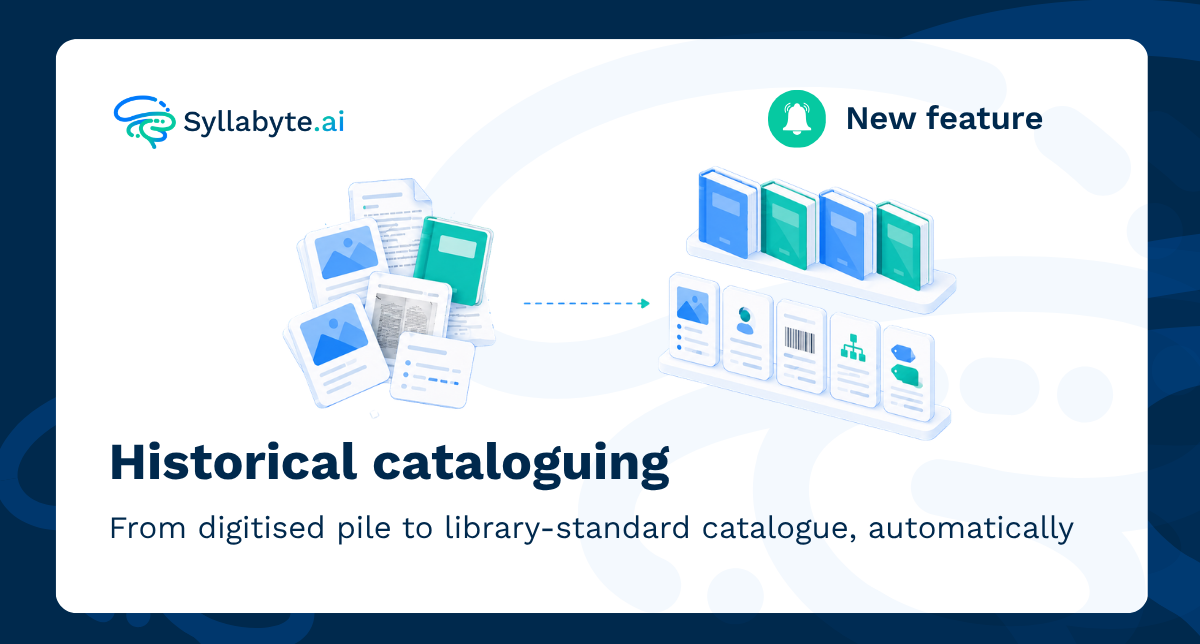
Historical Cataloguing
Anyone who has tried to bring historical or archival material into a modern catalogue knows the problem. The scanned letters, the old journal issues, the institutional archive boxes finally digitised after decades, none of it arrives with the structured information a library system actually needs. There's no ISBN. No publication date. No consistent record of who or what is being discussed, and historical documents are notorious for referring to the same person three different ways on the same page.
And yet, before any of that material can go into a library catalogue, a discovery platform, or an institutional repository, it has to meet the same standards used to manage millions of other items worldwide. It needs a content type. It needs names linked to authoritative records, not just text strings. It needs to fit into systems built for precision at scale.
Doing that by hand requires a specialist cataloguer and a great deal of time. Doing it wrong means content nobody can find, records that get rejected downstream, or people and places that end up misidentified across an entire collection.
Syllabyte now handles this automatically.
Knowing what something is
Libraries use a single, standardised vocabulary, maintained by the Library of Congress, to record what kind of content an item is. Is it text? A photograph? A video recording? Sheet music? This field is expected by every library system and academic discovery layer that touches the record, and getting it wrong means the item gets miscatalogued.
Syllabyte now reads a piece of content and classifies it using this exact standard, applying the same logic a trained cataloguer would. A scanned letter is text, not an image, because what matters is that someone can read it, not how it was captured. The suggestion appears for a cataloguer to confirm, so the judgement call stays with a person while the groundwork gets done automatically.
Knowing when something was written
Most archival material has no publication date attached, but knowing roughly when something was written turns out to matter for almost everything else done with it afterwards.
Syllabyte now reads a document and works out its likely era from the same clues a historian would use: a date in a masthead, a volume number that traces back to a founding year, a dateline on a letter, references to events, or even the vocabulary and writing style typical of a period. The result is a best-guess year, a plausible range, a confidence rating, and a plain-language explanation of what led to that estimate.
That estimate only gets saved to the record automatically when confidence is high or medium. Low-confidence guesses are flagged for a person to look at, never applied silently. And if a date already exists on the record from any other source, Syllabyte leaves it alone.
Knowing who and what is being talked about
Historical documents are full of names, and those names rarely appear the same way twice. "Virginia Woolf", "V. Woolf", and "Woolf, Virginia" are obviously the same person to a reader, but a catalogue that treats them as three separate entries just makes the collection harder to search.
The Library of Congress maintains a definitive public register of names, the Name Authority File, used by libraries everywhere. Syllabyte now reads through a document, finds every person, organisation, and place it mentions, and checks each one against that register. Where a match exists, the record gets the authoritative form of the name, a permanent Library of Congress identifier, and, where available, the international identifier publishers and rights bodies use. Every variant of a name collapses into that single, definitive entry.
Why these work better together
Here's where it gets genuinely useful rather than just convenient. The Library of Congress register holds records for people across all of recorded history, which means name matching on its own can go wrong in obvious ways. A Victorian journal mentioning "Dr. Johnson" could just as easily match a present-day doctor with the same surname as the historical figure actually being discussed.
Knowing the era a document was written in fixes that. Once Syllabyte has worked out that a document dates from around 1871, it uses that to rule out anyone who couldn't plausibly have been the person referenced, filtering out matches to people born decades after the document was written. A reference to "Dr. Paget" in an 1870s journal correctly resolves to the historical figure, not a modern namesake. No extra input is needed from a cataloguer for this to happen.
Your own classification on top
Library standards solve the "globally portable" half of the problem, but most organisations also need to sort content against their own systems: subject areas, difficulty levels, curriculum frameworks, or internal taxonomies specific to a collection. Syllabyte's custom list classification works alongside this new cataloguing capability, so the same content that's already been classified and authority-linked can also be matched against any number of your own custom lists, with suggestions appearing in the same review queue.
What this unlocks
- Library-standard content classification generated automatically, with a person confirming every suggestion before it applies
- Publication era estimated directly from a document's own content, for material that has never had a date attached
- Names, organisations, and places linked to permanent, authoritative records instead of inconsistent text strings
- Far more accurate name matching for historical collections, since era detection filters out anachronistic matches automatically
- Your organisation's own classification schemes layered on top of the same processed content, no extra setup required
Try it now
These capabilities run automatically as part of Syllabyte's content processing pipeline. Upload historical or archival material as you normally would, and review the suggested classifications, dates, and authority-linked names in your usual review queue.
Explore More News & Updates
Discover more articles about AI in educational publishing, customer success stories, and industry trends.