Standards Alignment for Educational Publishers
Linking educational content to curriculum frameworks is one of the most persistent operational challenges in publishing. This guide explains how standards alignment works, where complexity arises, and what it takes to manage it at scale.
Educational publishers operate in a complex ecosystem of curriculum frameworks, learning objectives and assessment standards. Schools, teachers and institutions increasingly expect content to be clearly aligned to recognised standards so that learning materials can be easily mapped to specific outcomes.
Standards alignment is therefore not simply a marketing feature. It is a core part of how educational content is structured, discovered and used within teaching and learning environments.
What is standards alignment?
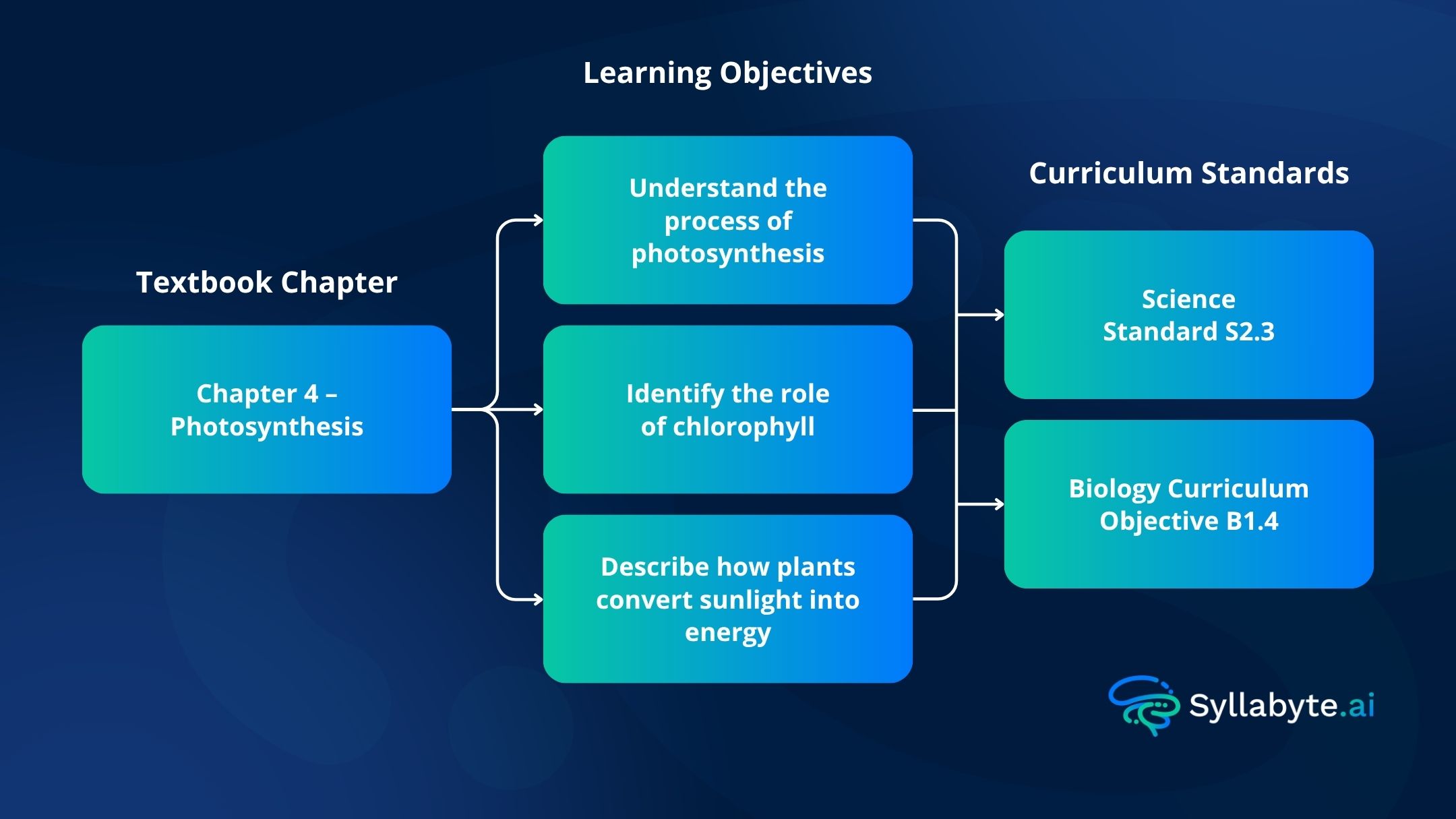
Standards alignment is the process of linking educational content to curriculum frameworks and learning objectives so that educators can identify which materials support specific skills or knowledge areas.
For publishers, this often involves mapping chapters, lessons or activities to:
- Curriculum standards
- Subject frameworks
- Learning objectives
- Assessment criteria
This alignment allows content to be organised and discovered in ways that support curriculum delivery and educational outcomes.
Why standards alignment matters
Clear alignment helps educators understand how content supports the curriculum they are teaching. It also allows publishers to demonstrate how their materials meet specific educational requirements.
As digital learning environments become more data-driven, alignment metadata also plays an important role in powering search, recommendations and reporting. For publishers supplying content to adaptive learning platforms, alignment also plays a structural role. When content is mapped to objectives at a granular level, it becomes possible to substitute or adjust passages, increasing or reducing complexity, while preserving the intended learning outcomes. The content changes; the objective does not. This is what makes genuinely personalised learning scalable: each learner can take a different path through the material and still reach the same destination.
Content discovery
Teachers can find materials that match specific curriculum points without manually reviewing entire catalogues.
Curriculum mapping
Publishers and institutions can audit coverage across frameworks and identify gaps in learning pathways.
Platform integration
Structured alignment metadata enables content to connect reliably with digital learning platforms and LMS systems.
Outcome evidence
Well-structured alignment data helps publishers demonstrate how content supports defined learning outcomes, competency frameworks and institutional requirements.
Where workflows break down
Many publishers still manage alignment using manual or semi-manual processes. This can create challenges when working across large catalogues or multiple curricula. As a catalogue grows, these challenges can quickly multiply.
Mapping content across different regional standards
Content that works in one market often needs to be realigned for different national or state-level frameworks, requiring significant editorial effort with each new territory.
Maintaining consistency across editorial teams
When multiple teams are responsible for tagging and aligning content, variation in interpretation becomes difficult to manage without clear governance and tooling.
Updating alignments when standards change
When a curriculum framework is revised, publishers face the challenge of reviewing and updating alignments across large catalogues. Standards change regularly, and keeping pace under time pressure adds to the complexity.
Tracking which content supports which objectives
Understanding where objectives are covered, and identifying gaps or duplication, becomes increasingly difficult without structured metadata at the foundation.
Demonstrating outcome coverage to external stakeholders
Publishers increasingly need to provide clear, client-friendly evidence showing how content aligns to curriculum outcomes, institutional requirements, custom frameworks and workforce standards such as O*NET. Producing this evidence manually across large catalogues can become difficult to maintain, especially when frameworks evolve over time.
Granular alignment also makes it possible to map the relationships between content items, not just what each piece covers. Is one item a prerequisite for another? Does it reinforce or extend a related objective? How strong is that link, and can the connection be justified? Publishers who capture this relational layer begin to build something more valuable than a tagged catalogue: a knowledge graph of how their content coheres as a curriculum. A learner cannot follow Pythagoras’ theorem without first understanding what a right angle is. That dependency exists whether or not it has been mapped.
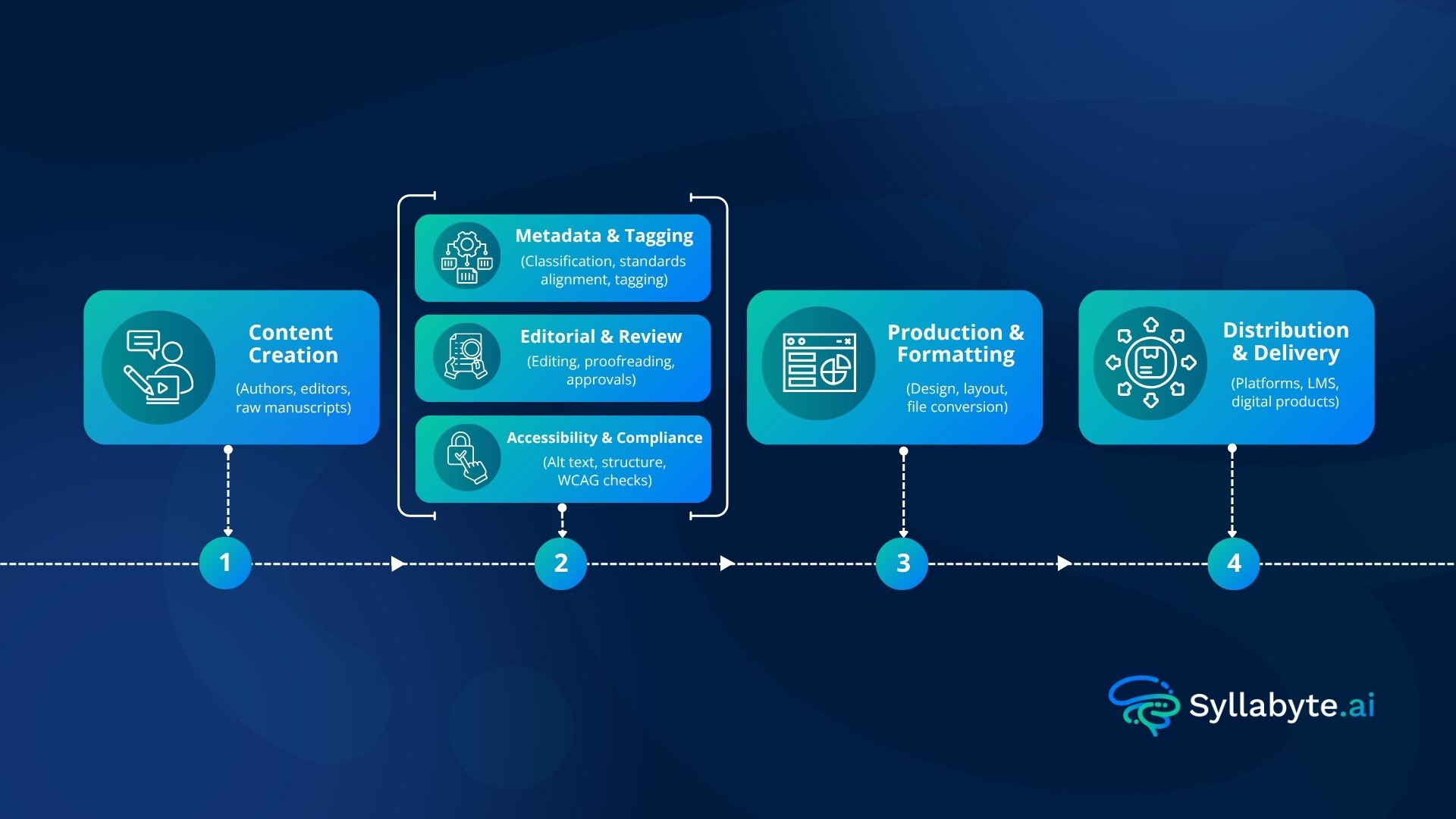
Structured content
Components that can be tagged and aligned independently
Consistent metadata
Standardised fields applied consistently across the catalogue
Taxonomy frameworks
Controlled vocabularies aligned to recognised standards bodies
Workflow tooling
Processes and platforms for managing alignment at catalogue scale
Moving towards scalable alignment
To manage alignment effectively at scale, publishers increasingly rely on structured content, consistent metadata and well-defined taxonomy frameworks.
These foundations allow learning objectives, curriculum standards and content elements to be connected in ways that support both editorial workflows and digital learning systems.
Technology platforms can then help publishers manage these relationships across large catalogues and evolving curriculum requirements.
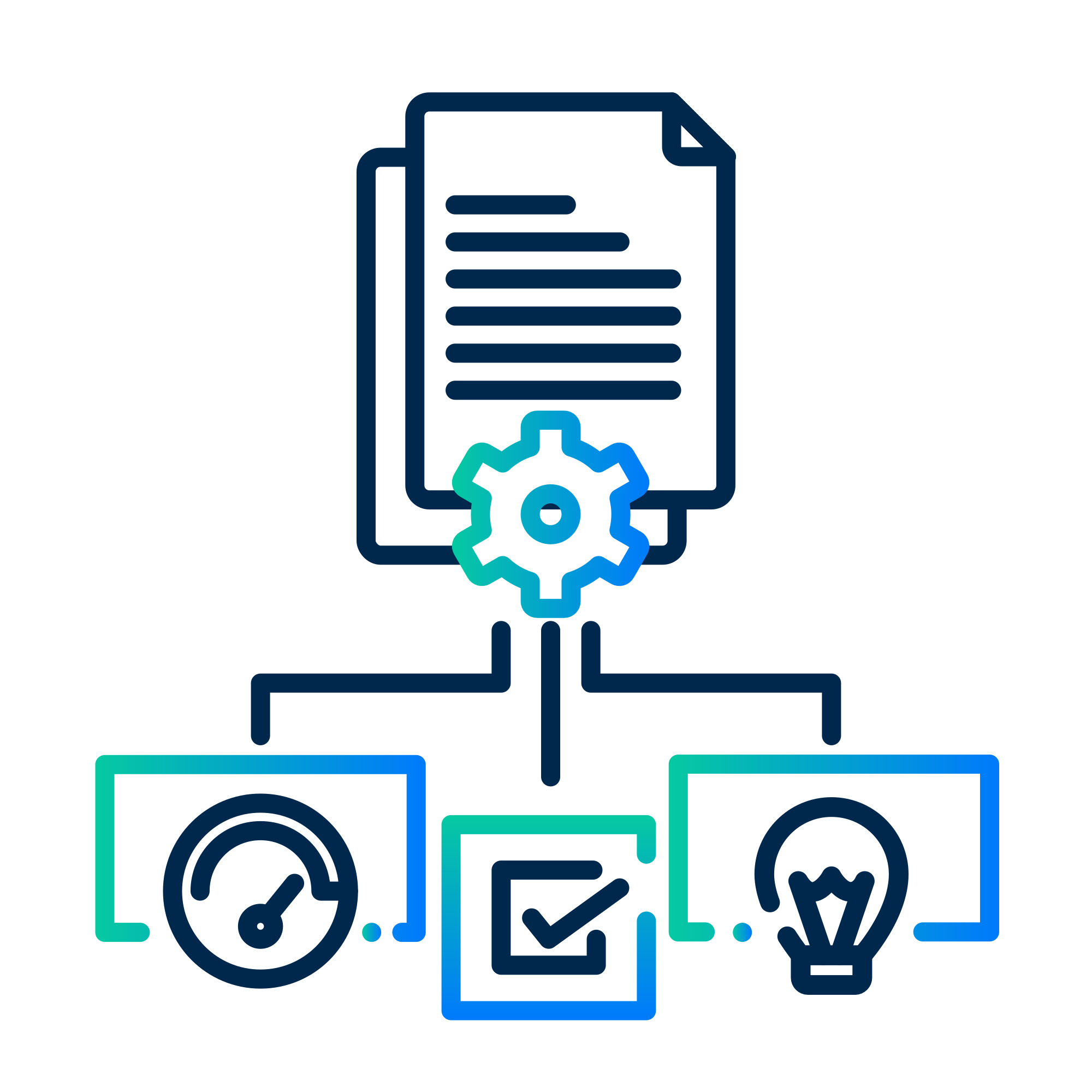
Syllabyte Platform
Alignments and Classifications
Automatically align content to educational standards and classify against custom taxonomies with AI-powered precision.
How technology supports standards alignment at scale
Managing alignment manually becomes unsustainable as catalogue size grows and the number of frameworks increases. Technology platforms address this by automating the mapping of content to standards, maintaining alignment as frameworks evolve, and making relationships visible across large content sets.
Effective platforms combine AI-assisted tagging with structured taxonomy management, allowing publishers to align content to multiple regional standards from a single workflow, validate alignment quality, and distribute metadata reliably to downstream platforms.
Syllabyte is built around exactly this workflow. Its Alignments and Classifications module helps publishers align content to educational standards across jurisdictions with AI-powered precision, reducing the manual overhead that comes with large-catalogue compliance.
Further reading
Curriculum Updates
Tracking curriculum and standards updates
Stay up to date with changes across curriculum frameworks and education policy.
Read moreArticle
Why manual standards alignment breaks down at scale
A closer look at the challenges publishers face when managing alignment at scale, and what tends to go wrong first.
Read moreProduct
Metadata management for educational content
How structured metadata supports alignment, discovery and reuse across publishing workflows.
Read moreReady to discuss your alignment workflow?
We work with editorial and product teams to understand how alignment fits into your content operations.